
“History began when humans invented gods, and will end when humans become gods.”
– Yuval Noah Harari
Why I Picked This Book
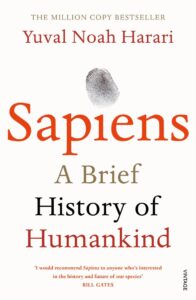
I don’t usually pick up non-fiction while expecting existential whiplash, but Sapiens is that one rare beast. It was handed to me by my father because he wanted me to get out of my dreamworld. Unfortunately for him, I included this in my delusional world too. This book doesn’t just tell the story of humans; it questions everything we believe about ourselves. From religion and capitalism to biology and imagination. If you’ve ever wondered, Why do we do what we do? This book is for you.
What Is Sapiens About?
At its core, Sapiens is a timeline, but not a boring one. It traces how a relatively unremarkable species of ape (spoiler: us) went from just another animal on the African savanna to becoming the rulers of the world.
Harari divides human history into 4 major revolutions:
-
Cognitive Revolution (70,000 years ago) – When we started telling stories and imagining things that didn’t exist, and we still continue to do this. It’s more like our instincts at this point.
-
Agricultural Revolution (10,000 years ago) – When we domesticated wheat (or did it domesticate us?). Most of us now can’t even imagine our lives without food items like wheat, rice, etc.
-
Unification of Humankind – Through trade, empires, and shared mythologies like religion and money. It was the start of everything good and bad.
-
Scientific Revolution – When we stopped believing we had all the answers and began seeking them. If only we had done this more regarding gods and religion.
But here’s the thing, these aren’t just historical events. They’re psychological breakthroughs. Each revolution changed not just the world, but also how we think, feel, fear, and dream.
The Psychology of Sapiens: Let’s Break It Down
1. The Human Need for a Narrative
Psychologically, we’re wired for a story. Harari emphasizes how fiction — not fact — built civilizations.
Money? A shared belief.
Corporations? Legal fictions.
Religion? Sacred narratives.
These aren’t lies , but adaptive illusions, fulfilling our deep-rooted need for meaning and belonging. In psychology, this is tied to the cognitive schemas. It is a mental framework we create to navigate the world. Harari shows how the entire society is built on these collective schemas.
2. Cognitive Dissonance in the Civilization
The Agricultural Revolution, for example, didn’t make us happier, but more anxious, overworked, and possessive.
Harari aligns this with what psychologists call cognitive dissonance. It is when reality conflicts with belief that makes us we suffer because of it.
We believed that owning land meant security.
But in reality? It gave us nothing but wars, hierarchies, and disease.
3. The Myth of Free Will
A major psychological undercurrent in Sapiens is the idea that free will is a construct. Harari echoes what many psychologists (from Freud to Kahneman) suggest: that much of what we do is pre-programmed by biology, upbringing, and culture.
We think we’re choosing, but are we?
4. The Trauma of Progress
What we call “progress” often carries an emotional cost. The psychological toll of moving from small tribes to crowded cities reflects in modern issues. Which are:
-
Depression
-
Identity crises
-
Burnout
-
Loneliness despite connectivity
Harari didn’t just spell these out but kept them hidden between the lines for people to understand and know the issue in more detail.
The Golden Mindscape Lens: What Stuck With Me
Harari’s genius is in how he blends science with storytelling. It is what stuck with me because it’s literally my forte. You’re not just reading history, but walking through it, sometimes stumbling, often wide-eyed. The chapter that hit me the hardest? The one that questioned free will. Are we truly choosing, or are we just running scripts written by culture, evolution, and dopamine? This you can experience at this time and age too regarding many political and personal issues.
If you’re into psychology, philosophy, or slow, soul-searching introspection, Sapiens isn’t just a choice but a need.
Highlights I Annotated Like Crazy
- “You could never convince a monkey to give you a banana by promising him limitless bananas after death in monkey heaven.”
- “How do you cause people to believe in an imagined order such as Christianity, democracy or capitalism? First, you never admit that the order is imagined.”
- “Each year the US population spends more money on diets than the amount needed to feed all the hungry people in the rest of the world.”
-
“There are no gods, no nations, no money and no human rights, except in our collective imagination.”
- “We did not domesticate wheat. It domesticated us.”
Should You Read It?
If you:
-
Crave books that make you question everything?
-
Enjoy history but prefer it with soul and sarcasm?
-
Love digging into collective myths like money, marriage, and religion?
Then yes. Sapiens is a mirror and a map.
Heads-up: Some parts may feel controversial or unsettling. But that’s also where its power lies. It doesn’t want to comfort you. It wants to wake you up. After all art should comfort the disturbed and disturb the comfortable.
Final Thought
Sapiens isn’t just a book. It’s a reintroduction to yourself, although not the version in your mirror, but the version shaped by thousands of years of silent revolutions and loud delusions. Harari doesn’t ask you to agree. He dares you to think.
Have you read Sapiens? What myths do you think hold our society together? Or better yet — what myths are you ready to let go of?
Drop a comment and let’s untangle our timelines together.